The Uranium Thief
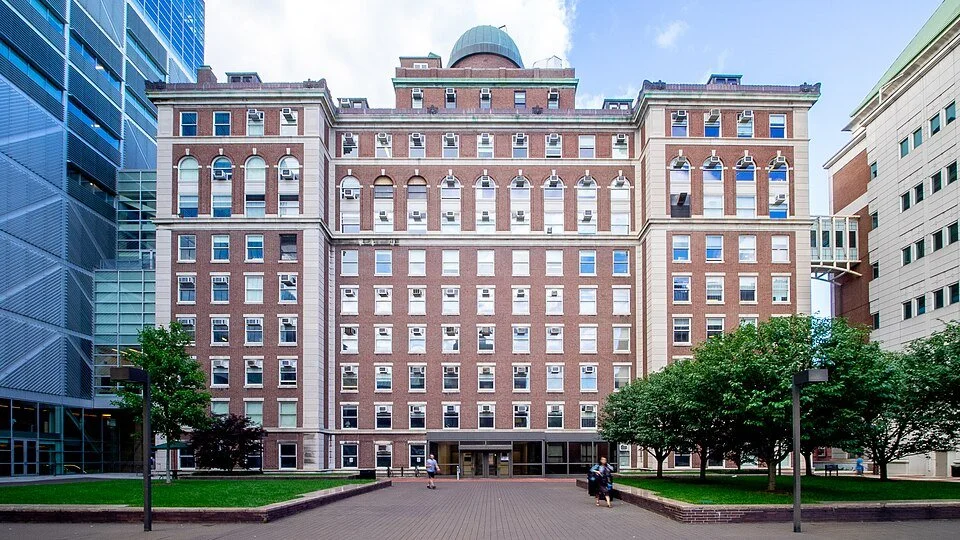
Pupin Hall, Columbia University, Manhattan
Ken Hechtman, a native of Canada, had ventured only a few miles by taxi across the Pakistan border into the Afghan city of Spin Boldak when he ran into trouble. Having followed bad advice to grow a beard and dress like a local, the computer programmer turned roving reporter was immediately conspicuous. His garb registered as a cunning disguise.
The war in Afghanistan began in October 2001, when the United States initiated armed operations against Al-Qaeda and the Taliban in response to the September 11 attacks, which killed nearly 3,000 people, most of them in Manhattan. The following month, having decided in his early thirties to try out journalism for a free Montreal newspaper, Hechtman set off to meet the Taliban against the better judgment of his bewildered editor.
When he called upon the Taliban’s local office to announce his arrival and request a visa, it may have been their lunch hour; no one was there to greet him. Undeterred in his mission, Hechtman visited the local hospital and refugee camp to nail his first interview. Tailed, naturally, by all-seeing eyes, he was arrested by the Taliban within a couple of hours and subsequently detained on suspicion of being a spy.
Prior to his release six days later, Hechtman told his captors that their jail “was not the worst I had been in. It was the third worst.” He was referring to his previous jail stints in Atlanta and the Bronx. His arrests in New York City alone were frequent. Contemporary interviews and later profiles describe his involvement in radical squatter movements on the Lower East Side in the late 1980s. Hechtman, then an anarchist, was once reported to have thrown cat feces at a Manhattan Community Board meeting. We can only assume the city authorities had a file on him that may have included his erstwhile adventures in a Manhattan project of his own making. Among his exploits—now part of Columbia University legend—is the following:
In February 1987, the Columbia Spectator reported that campus security and University Environmental Health Services searched the dorm rooms of first-year students Hechtman and Jeff Bankoff after residents of McBain Hall, part of Morningside Heights’ Ivy League sprawl, raised concerns about dangerous chemical experiments. Hechtman and Bankoff admitted taking chemicals and approximately 25 grams of uranium-238 from a laboratory accessed via tunnels beneath the Pegram Nuclear Physics Laboratory, attached to the historic Pupin Hall, Columbia’s Physics and Astronomy building. Hechtman, then 19, claimed they intended to conduct small experiments and “neat” pyrotechnic or scientific tests, including measuring the uranium’s radioactivity and possibly exposing plant seeds to radiation.
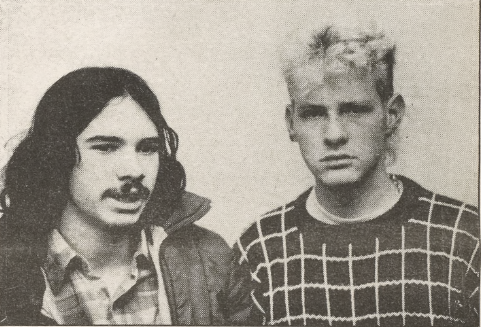
Ken Hechtman and Jeff Bankoff as Columbia freshmen, 1987. Source: Columbia Daily Spectator.
Hechtman was the leader of ADHOC, an acronym for Allied Destructive Hackers of Columbia, whose goal was to cause “anarchy and destruction.” This early stunt in his anarchic trajectory resulted in suspension and a requirement to reapply for admission.
He didn’t return to Columbia. Instead, after a long series of starring roles in the chaos of his own making—including his Lower East Side radicalism and his ill-fated, 9/11-inspired journey to Afghanistan—he and his wife Wendy were charged in Nebraska in 2017 with conspiracy to manufacture and distribute fentanyl analogues, as well as possession with intent to distribute. They pleaded guilty and were sentenced in 2018; Hechtman received 15 years in federal prison and was released on probation in 2023.
Ken Hechtman represents an inimical New York presence, and a guilty pleasure of the city’s underbelly. His disruptive antics form unlikely points of contact with far larger forces, including the literal fallout of nuclear fission. As a direct result of his illicit tunneling beneath Pupin Hall, some of the passageways were subsequently sealed off, drawing an even darker veil over the building’s top-secret history. The uranium-238 that Hechtman stole could not sustain a nuclear chain reaction, unlike uranium-235. But even a pickpocket-sized sample of uranium at that location would carry symbolic significance, given the pre–World War II discovery there, one that would help set in motion the atomic age.
Dr. John R. Dunning, a Nebraska native and professor of physics at Columbia University, split the uranium atom in the basement of Pupin Hall in January 1939. This experiment was a major factor leading to the Manhattan Project; the Los Alamos Laboratory in New Mexico—under the direction of New York native J. Robert Oppenheimer—developed the first atomic bomb in 1945.
Much of the history of the atomic age unfolded in Manhattan’s hidden spaces—its university tunnels and warehouses—before occasionally surfacing, Hechtman-style, in brazen passages through public places and forbidden zones.